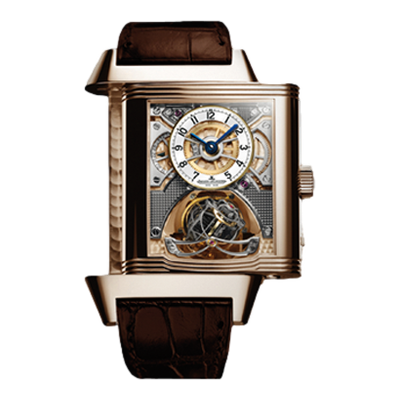
Jaeger-LeCoultre · Reverso
Reverso Gyrotourbillon 2
The Jaeger-LeCoultre Reverso Gyrotourbillon 2 is a pink gold handwound watch in the Reverso family.
- Reference
- 2332420
- Case size
- 36mm
- Case material
- Pink Gold
- Dial
- Skeleton
- Movement
- Cal. 174 · Handwound
- Water resistance
- 30m
- Power reserve
- 50 h (2.1 days)
Don't see one for sale?
Case
Diameter
36.00 mm
Height
15.80 mm
Material
Pink Gold
Glass
Sapphire
Caseback
Double Dial
Water Resistance
30.00 m
Dial
Color
Skeleton
Indexes
Stick / Dot
Hands
Stick
Shape
Rectangular
Other
Gender
M
Movement Specs
Caliber
174
Jaeger-LeCoultre in-house
Caliber Brand
Jaeger-LeCoultre
Type
Handwound
Manual winding
Power Reserve
50 h
2.1 days
Frequency
28800 bph
8.0 Hz
Jewels
58
Complications
Additional 24 Hour Hand (fixed), Hours, Minutes, Seconds, Tourbillon Escapement
About the Movement
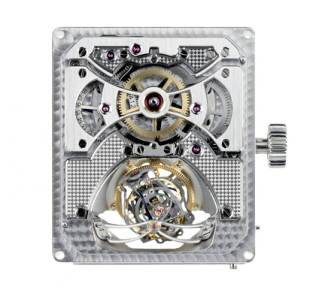
The spherical 'Gyrotourbillon' is one of Jaeger-LeCoultre's emblematic complications. Featuring such, caliber 174 consists of 373 parts and has a power reserve of 50 hours. Data on the tourbillon: * Outer carriage: aluminium, 60 seconds for a complete rotation * Inner carriage: titanium and aluminium, 18.75 seconds for a complete rotation * Balance: inertia of 12.5 mg x cm2 * Balance frequency: 28,800 vibrations per hour * Parts:100
About the Family
The Reverso was created in 1931 by René-Alfred Chauvot for polo players who needed a watch that could survive the impact of mallets and balls. The solution was elegant: a case that swivels within its cradle to present either the dial or a solid metal back. What began as a practical sports watch became one of the most distinctive case designs in watchmaking and Jaeger-LeCoultre's most recognised model. The reversible case has since been used as a canvas for enamel art, dual time zones, and even triple-calendar complications on the hidden face. No other watch case design has proven so versatile over so long a period — ninety years and the Reverso remains as relevant as the day it was drawn.
About this reference
The second version of the Gyrotourbillon is distinguished by an essential organ: the presence of a cylinder-shaped balance-spring with end curves. This component was invented by English watchmaker John Arnold, who had it patented in 1782. Due to the complexity involved in its production and the difficulties implied by attempts to miniaturise it, this ingenious discovery which guarantees a regular and perfectly isochronous development of the balance-spring was reserved exclusively for marine chronometers and a few generously sized pocket-watches. Innovative watchmakers chafed at this regrettable situation, since its rating characteristics are unanimously considered to be infinitely better than those of a flat balance-spring. The engineers and watchmakers of the Manufacture proved able to grasp the opportunity represented by the spherical tourbillon and to present a cylindrical balance-spring nestling at the heart of a wristwatch. Combined with the specific advantages of the spherical tourbillon, this innovation represents a breakthrough in the field of accuracy and paves the way for a level of rating precision that is simply unprecedented on a timepiece designed to follow its wearer’s arm movements.
Other references in this family
Reverso Gyrotourbillon 2
Skeleton dial
Reverso Répétition Minutes à Rideau
Skeleton dial
Reverso Répétition Minutes à Rideau
Skeleton dial
Reverso Classic Medium Stainless Steel / Silver
Silver dial
Grande Reverso 1931 Seconde Centrale
Black dial
Reverso Tribute Calendar Pink Gold / Silver / Alligator
Silver dial
Reverso Tribute Gyrotourbillon
Skeleton dial