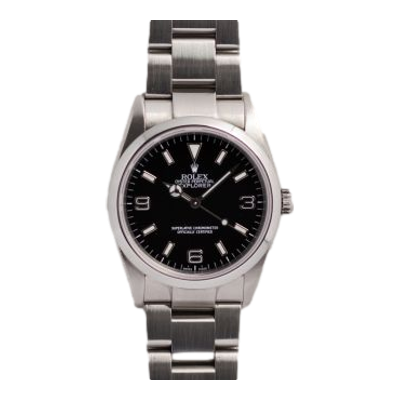
Rolex · Explorer
Explorer
The Rolex Explorer is a stainless steel automatic watch.
- Reference
- 114270-0001
- Case size
- 36mm
- Case material
- Stainless Steel
- Dial
- Black
- Movement
- Cal. 3130 · Automatic
- Water resistance
- 100m
- Power reserve
- 48 h (2 days)
Don't see one for sale?
Case
Diameter
36.00 mm
Lug Width
20.00 mm
Material
Stainless Steel
Glass
Sapphire
Caseback
Closed
Water Resistance
100.00 m
Dial
Color
Black
Indexes
Arabic Numerals
Hands
Stick
Shape
Round
Other
Gender
M
Production
2001–2010
Movement Specs
Caliber
3130
Rolex in-house
Caliber Brand
Rolex
Type
Automatic
Perpetual rotor
Power Reserve
48 h
2 days
Frequency
28800 bph
8.0 Hz
Jewels
31
Complications
Hours, Minutes, Seconds
About the Movement
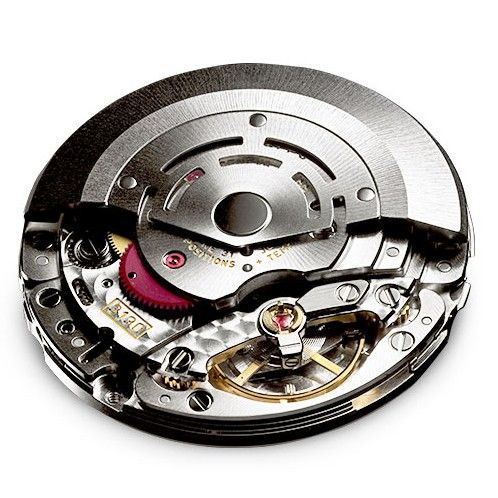
This model is equipped with calibre 3130, a self-winding mechanical movement entirely developed and manufactured by Rolex. Like all Rolex Perpetual movements, the 3130 is a certified Swiss chronometer, a designation reserved for high-precision watches that have successfully passed the Swiss Official Chronometer Testing Institute (COSC) tests - though versions without also exist. It is fitted with a Parachrom hairspring, offering greater resistance to shocks and to temperature variations. Its architecture, in common with all Oyster watch movements, makes it singularly reliable.
About the Family
The Explorer was born from Rolex's relationship with Himalayan expeditions in the 1950s, culminating in the successful ascent of Everest by Edmund Hillary and Tenzing Norgay in 1953. The watch they carried — a prototype that would become the Explorer — proved that a Rolex could function reliably at extreme altitude, in extreme cold, and under extreme physical duress. The Explorer's design codified these requirements: a 36mm (now 40mm) Oyster case, black dial with 3-6-9 Arabic numerals for maximum legibility, Mercedes hands with luminous fill, and no complications beyond the time. It is Rolex's purest expression of the tool watch — nothing unnecessary, nothing missing.
About this reference
The Rolex Explorer 114270 was introduced in 2001 as the successor to the 14270. It is powered by caliber 3130 (was 3000) and features a bracelet with solid end links.